

 Product added to cart





What is LED lighting for furniture?
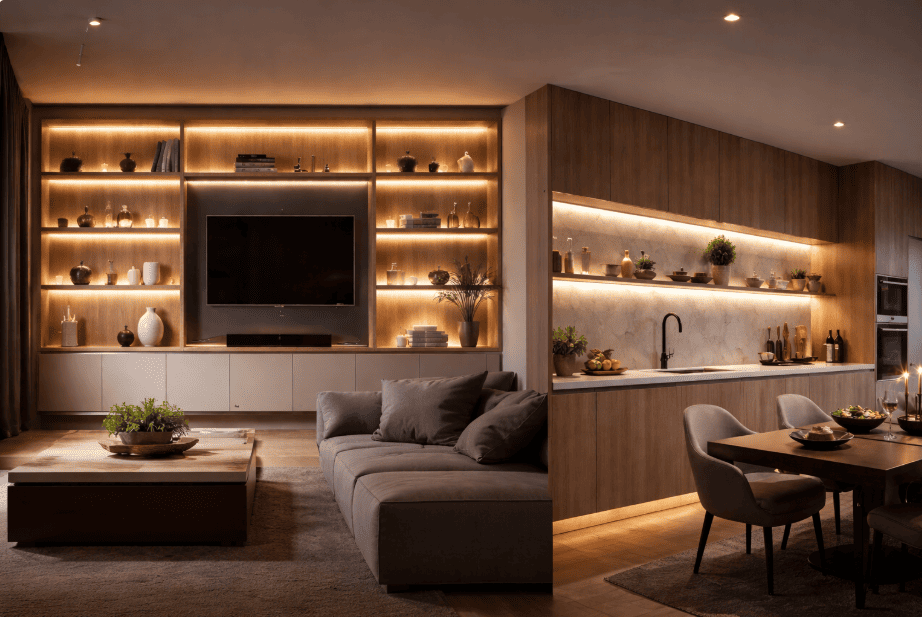 LED lighting for furniture – is a local lighting system that is integrated directly into the design of cabinets, kitchens, shelves, wardrobes, sideboards, display cases, and other interior elements to enhance the functionality, comfort, and visual appeal of a space. Furniture lights are installed where people need to see details—in the food preparation area, in the wardrobe when choosing clothes, in pull-out drawers, on shelves with dishes or documents.
LED lighting under the kitchen countertop allows you to cook without shadows from the upper cabinets, and lighting inside the cabinet makes it possible to quickly find the right item even in deep compartments. LED lighting in pull-out drawers eliminates the need to turn on the main light at night, and a well-lit work area reduces the risk of injury when cutting food or working with tools.
Lighting steps or furniture in a dark hallway helps to avoid accidental collisions. Light emphasizes the texture of wood, glass, or metal, creates the effect of a “floating” nightstand or bed, and highlights a niche or decorative element. In commercial spaces, furniture lighting draws attention to the product and increases its appeal.
In the kitchen, lighting is installed under wall cabinets, inside modules, in glass display cases, and in bar counter areas. In dressing rooms and wardrobes, light is mounted along shelves or vertically on side walls for even distribution. In living rooms, lighting is used in TV areas, bookshelves, and decorative niches. In bedrooms, it is used in bedside tables, headboards, or under the bed to create soft night lighting.
Lighting for furniture allows you not only to turn the light on and off, but also to control its brightness, temperature, and operating scenarios. Solutions are available for furniture lighting with touch control, door opening sensors, motion sensors, timers, and dimmers. The light can turn on automatically when the cabinet is opened or gradually change brightness depending on the time of day.
There are systems with adjustable color temperature – from warm light around 3000K to neutral 4000K and cold 6000K – which allows you to adapt furniture lighting to specific tasks. Furniture lighting can be synchronized with general lighting, creating scenarios for evening mode or automatic shutdown.
LED furniture lighting technology
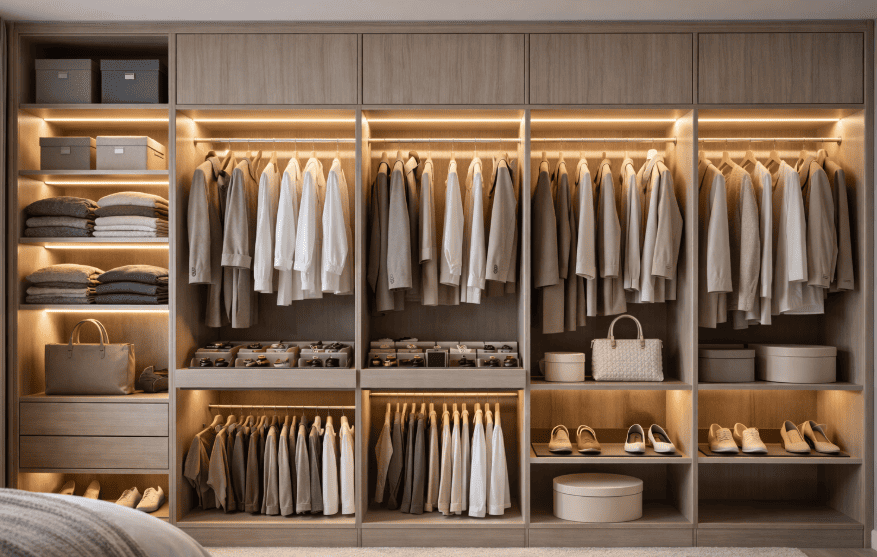 Furniture systems use LED strips, linear modules, or compact spotlights that operate at a low voltage of 12V or 24V DC, ensuring safe operation of furniture lighting even in wooden or laminated cabinets.
LED systems allow you to create a uniform light line without visible points of light, for which aluminum profiles with diffusers are used, which perform two functions: cooling and uniform light distribution. Aluminum dissipates heat from the LED crystals, which extends their service life and prevents degradation of the light flux.
LED technology allows for various options for installing lighting in furniture – recessed, surface-mounted, corner, and concealed. The flexibility of LED strips allows them to follow the complex shapes of furniture, and the compactness of LED modules allows light to be integrated even into narrow profiles or minimalist designs.
Fittings for furniture lighting of our own production
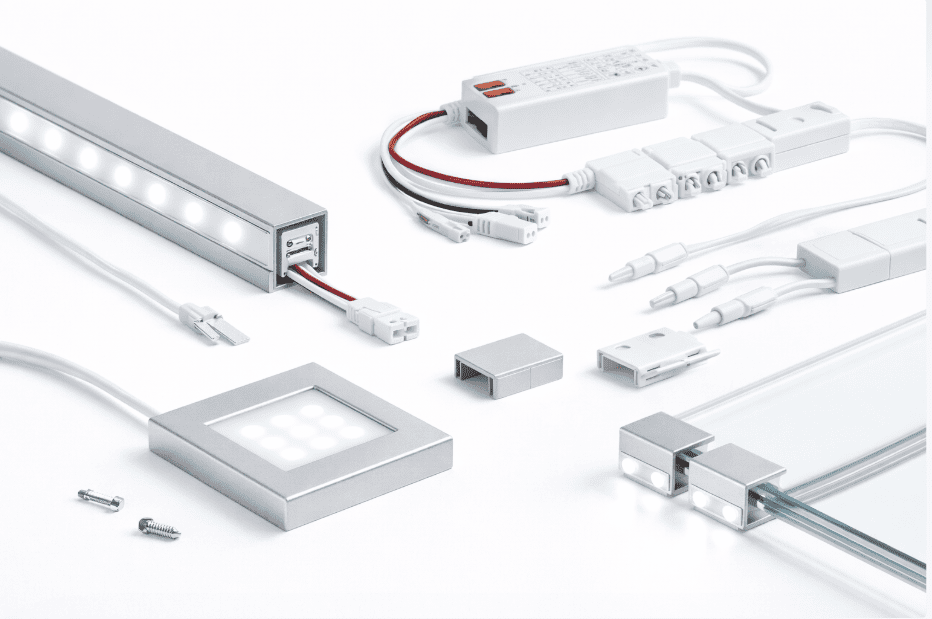 Furniture lighting accessories are a set of mounting, electrical, and connecting elements that ensure correct installation, safe connection, and long-term operation of LED lighting in furniture structures. High-quality furniture fittings for LEDs are the engineering basis of the entire furniture lighting system and determine the stability of the fastening, heat dissipation, reliability of contacts, and ease of use.
Furniture fittings for LED include aluminum profiles, diffusers, end caps, mounting clips, connectors, wires, power supplies, sensors, switches, controllers, cable glands, and other elements that form a complete system.
- Aluminum profiles for LEDs perform two functions at once – they dissipate heat from the LED crystals and stabilize the temperature.
- A diffuser is a transparent or matte insert that covers the profile from above and evenly distributes light, reduces the “dot” effect, and protects the tape from dust and mechanical damage. A matte lens produces a softer light, while a transparent lens maintains maximum brightness.
- End caps provide an aesthetic finish to the profile and protect the interior from dust.
- Mounting clips or mounting plates allow the profile to be securely attached to the surface without deformation.
- Connectors and connecting elements are used for quick connection of strips without soldering and allow you to connect sections of LED strips to each other, form corners or transitions.
- A power supply or driver converts 220V AC voltage to 12V or 24V DC voltage, which is required for LED lighting.
- Touch switches, dimmers, and motion sensors can be built-in or surface-mounted, responding to door opening, touch, or movement.
- RGB or CCT controllers are used for systems with adjustable light temperature or color lighting and allow you to change the lighting of furniture as needed.
The quality of furniture fittings for organizing LED lighting directly affects its service life and quality. Insufficient cooling due to the absence of a profile reduces the LED's service life several times over. Unreliable connections cause the contacts to heat up and cause malfunctions. An incorrectly selected power supply leads to flickering or system failure.
Fittings are selected depending on the type of furniture and the method of installation. Mortise profiles are installed in a pre-prepared groove and form the most accurate light line possible. Surface-mounted profiles are installed without milling and are suitable for ready-made furniture. Corner profiles are used to illuminate joints or internal corners of cabinets. When designing the system, the depth of the furniture module, the thickness of the material, the method of opening the facades, and access to the power supply are taken into account.
Clips for lighting glass shelves
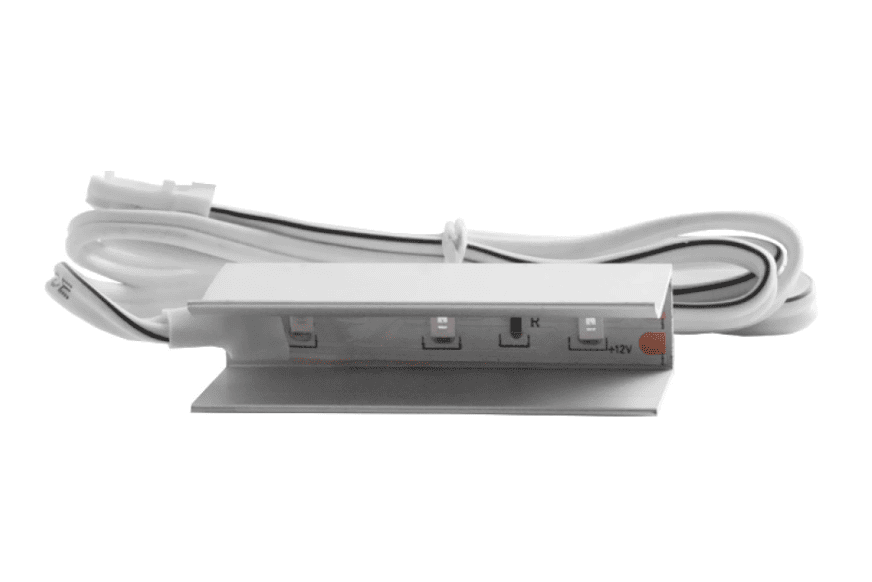 Clips for lighting glass shelves combine the function of mechanical glass fastening and an integrated light source. They fix the glass shelf in the furniture body or on the wall and at the same time provide uniform illumination of its end or surface. This solution is widely used in display cases, retail shelving, kitchen units with glass, bar areas, beauty salons, and jewelry stores.
The illuminated furniture clip is installed along the edges of the glass or along the back wall and forms a controlled light line without the need for complex profile installation, which simplifies the integration of lighting into existing furniture.
Clips for lighting glass shelves operate at a low voltage of 12V or 24V DC, which ensures safe operation in furniture structures. The power consumption of a single clamp usually does not exceed 1–3 W, which allows you to create multi-level systems with minimal energy consumption.
In home interiors, clips for lighting glass shelves are installed in display cases for dishes, decorative niches, bar cabinets, and dressing rooms with transparent shelves. In commercial premises, clips for lighting glass shelves are used to display goods such as cosmetics, jewelry, electronics, and accessories. In beauty salons and showrooms, illuminated shelves create a modern look and help to highlight individual areas without the need to install complex lighting systems.
Catalogue of LED-UA clips for lighting glass shelves - https://leduastore.com/furniture-lighting-ledua-brand/clips-for-glass-shelf-lighting/
Battery-powered furniture lights and low-voltage 5V clips
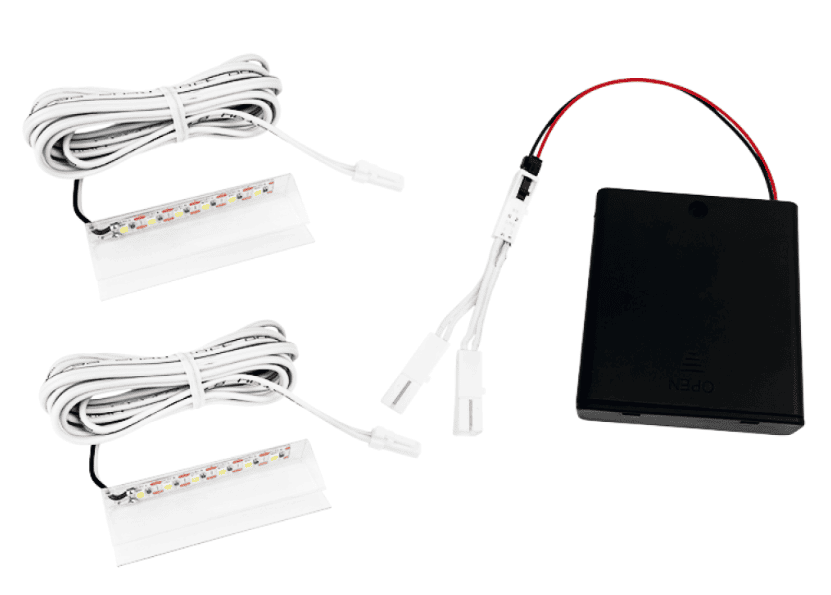 Battery-powered furniture lights and 5V clips are autonomous LED solutions for furniture lighting that operate without a 220V connection and do not require the installation of a power supply unit. Such devices are designed for local lighting of cabinets, shelves, niches, wardrobes, kitchen modules, or display cases in cases where wiring is difficult or impractical, and their main advantage is mobility, quick installation, and the ability to install them in ready-made furniture without milling or interfering with the structure.
A 5V power supply means operation from a standard low voltage, which can be provided by AA or AAA batteries, rechargeable batteries, or via a power bank's USB port. Modern models often use built-in lithium batteries that can be recharged via a USB-C or micro-USB cable, which simplifies operation and reduces the cost of replacing batteries.
Advantages of battery-powered furniture lights and 5V clips
The main advantage of battery-powered furniture lights is complete autonomy, which allows you to install lighting anywhere, and installation takes a minimum of time and does not require special tools. The low voltage of 5V makes the system safe for use in domestic conditions. The power of 5V furniture lights and clips is limited, so it is advisable to use them as auxiliary or accent lighting.
Catalog of battery-powered furniture lights and 5V clips LEDUA - https://leduastore.com/furniture-lighting-ledua-brand/furniture-lamps-on-batteries-5v-clips/
LED lighting for furniture shelves
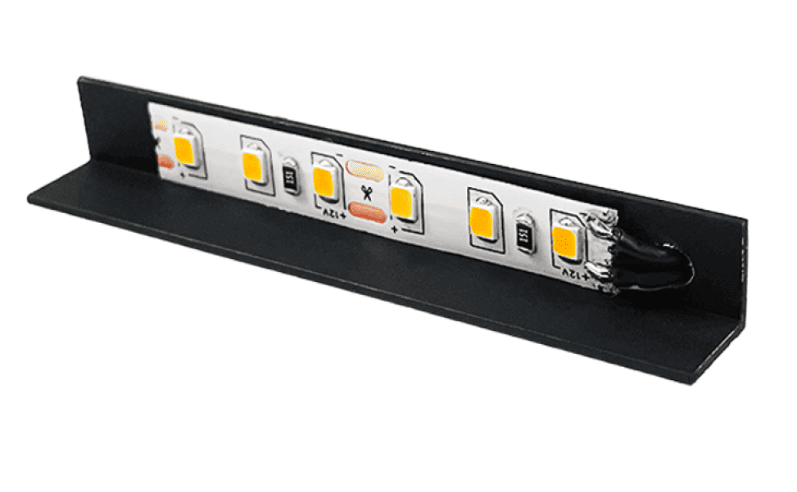 LED lighting for furniture shelves is an LED strip installed in an aluminum profile that integrates into the design of racks, cabinets, display cases, or niches to increase visibility, create accents, and improve the overall ergonomics of the space. LED shelf lighting forms a clearly directed light beam without shadows or glare, which is especially important for displaying items or comfortable use of furniture.
For glass shelves, end LED modules or special clamps are used to direct the light to the edge of the glass, so that the light beam spreads across the entire surface of the shelf and creates an internal glow effect.
The supply voltage of LED lighting for furniture shelves is 12V or 24V. Energy efficiency allows you to create a multi-level lighting system with minimal power consumption, and the service life of high-quality LEDs exceeds 30,000 hours.
LED lighting for furniture shelves can be recessed or surface-mounted. Recessed installation involves preparing a groove in the shelf or cabinet material and ensures the most accurate appearance without protruding elements. Surface mounting is used in cases where the furniture is already assembled. The profile or luminaire is attached to the bottom of the shelf with clips or screws. For glass structures, end mounting with clamps or rear placement of the LED module is used.
The ability to use dimmers or touch switches allows you to adjust the brightness and create different lighting scenarios.
Catalog of LED lighting for furniture shelves - https://leduastore.com/furniture-lighting-ledua-brand/furniture-shelf-lighting/
Furniture switches and chargers for furniture lighting
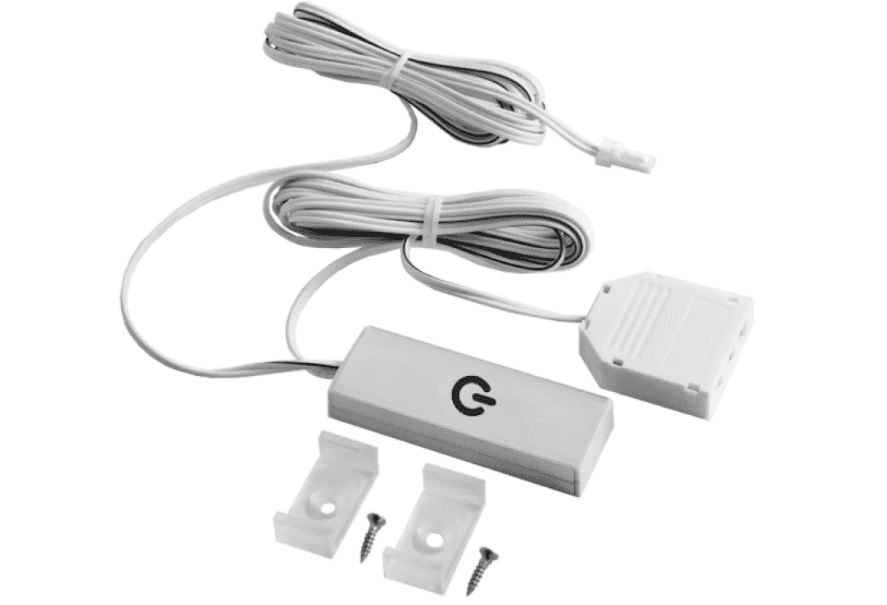 Furniture switches and chargers for furniture lighting ensure stable, safe, and convenient operation of LED systems in cabinets, kitchens, wardrobes, and display cases.
A furniture switch is a compact control element integrated into the furniture body or installed concealed. Its main task is to control the power supply to the LED system without using a standard wall switch. The most common types of furniture switches are:
- Mechanical contact switches that are activated when the door is opened or closed. When the front is opened, the contact opens or closes, and the lighting turns on automatically. This solution is often used in wardrobes and kitchen modules.
- Contactless touch switches operate on the basis of an infrared sensor or proximity sensor. The light is activated by hand movement or door opening without mechanical pressing. This is convenient for kitchens where hands may be busy or wet.
- Dimmers for furniture lighting allow you to adjust the brightness of the light.
- Push-button flush-mounted switches are installed in the furniture body and provide classic manual control.
A power source is required for the stable operation of the LED furniture lighting system. Stationary solutions use a power supply unit that converts 220V AC to 12V or 24V DC, while autonomous systems use charging modules.
LEDUA furniture switch catalog - https://leduastore.com/furniture-lighting-ledua-brand/furniture-switches-chargers/
LED furniture lighting kits
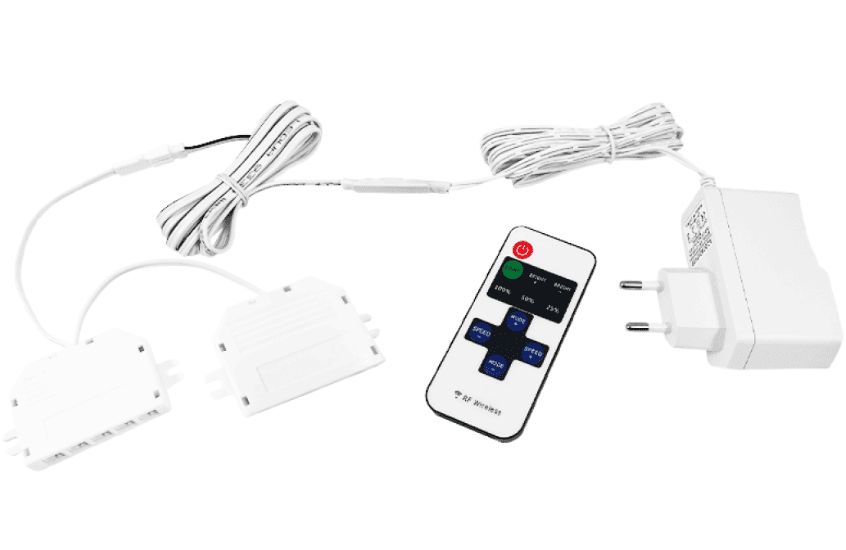 LED furniture lighting kits are complete systems that contain all the necessary components for quick connection of lighting without having to select each element separately. The kit includes an LED module or strip, driver or power supply, switch, junction box, connecting cables, dimmer, and remote control.
LED furniture lighting kits are convenient for furniture manufacturers because they allow for quick integration of lighting during assembly. They are also an optimal solution for modernizing existing furniture without complicated electrical circuit design. LED furniture lighting kits are an effective solution for creating a complete lighting system with minimal effort.
LEDU LED furniture lighting kits - https://leduastore.com/furniture-lighting-ledua-brand/lighting-kit/
Linear furniture lights
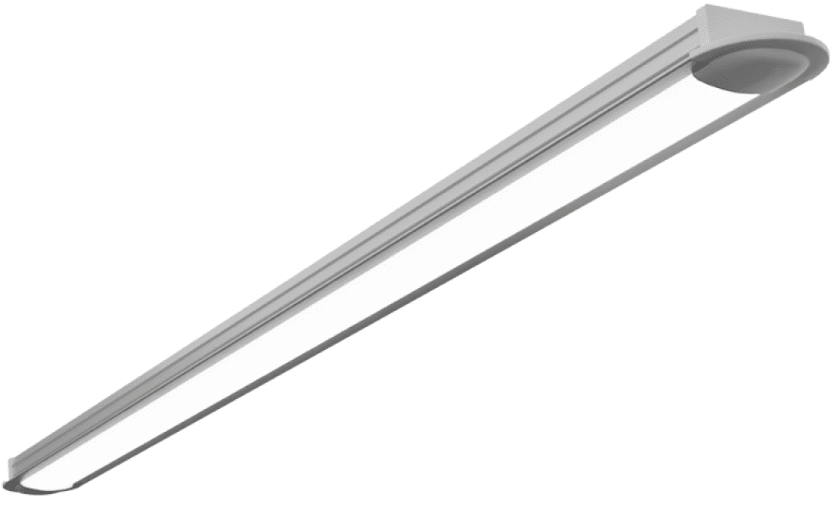 Linear furniture lights are LED modules in a compact housing designed to form a continuous line of light inside or under furniture elements. This is a ready-made luminaire with an integrated housing, diffuser, and contact group for quick connection. Linear furniture luminaires are used where uniform lighting is required under kitchen cabinets, in wardrobes, on open shelves, in niches, display cases, and work areas.
A linear furniture luminaire consists of an aluminum or steel housing, an LED board, an optical diffuser, and a built-in contact part. The luminaires operate on low voltage 12V or 24V via a power supply unit. The length of the luminaires varies from 150–200 mm to 1000 mm and more. For long furniture lines, it is possible to connect several linear furniture luminaires into a single system via connectors or a distribution block.
Linear furniture luminaires are available in surface-mounted or recessed versions. Surface mounting involves attaching the housing to the underside of a shelf or cabinet using clips or screws. Recessed mounting requires a groove to be prepared in the furniture body, allowing the luminaire to be integrated flush with the surface. There are also corner models that are installed at the junction of two planes, for example, between the wall and the bottom of a kitchen cabinet.
Catalog of linear furniture lights LEDUA https://leduastore.com/furniture-lighting-ledua-brand/linear-furniture-luminaires/
Lamps for illuminating glass shelves
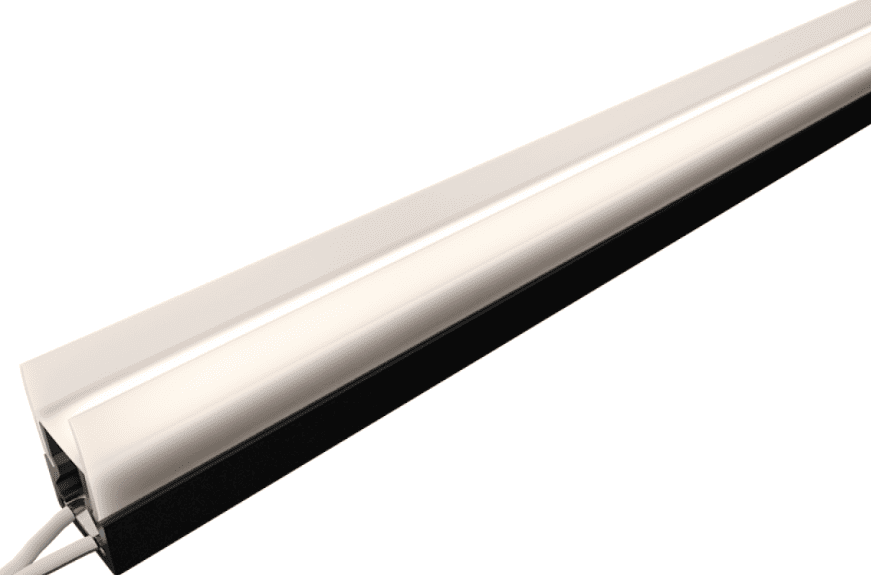 Lamps for illuminating glass shelves are specialized LED solutions designed to work with the light-conducting properties of glass, where the light flux not only illuminates the plane from above or below, but also passes through the end face of the glass, scattering throughout its entire thickness. This effect creates a characteristic glow around the contour or across the entire surface of the shelf, allowing you to illuminate objects and highlight the glass structure itself. Such luminaires are used in display cases, bar structures, cabinets with decorative elements, retail shelves, jewelry stores, and showrooms.
Glass has the ability to conduct light within its structure, and if the LED module is placed at the end of the shelf, the light flux enters the edge and spreads inside the material.
Types of luminaires for illuminating glass shelves
- Clamps with an integrated LED module simultaneously fix the shelf and illuminate its end. These models are compact and suitable for glass with a thickness of 5–10 or 8–12 mm.
- Linear profiles located along the back wall of the furniture, where light enters the glass from the rear.
- Spotlights with a directed light beam illuminate objects on the shelf without the effect of internal glow.
- RGB luminaires for glass shelves allow you to change the color of the backlight for decorative or commercial purposes.
Luminaires for glass shelves are mounted without milling the glass. Clamps are installed on the edge, profiles are installed on the furniture body, and the wiring is hidden in the back of the structure. The power supply is selected based on the total load and placed in the ventilation area. If necessary, the system can be supplemented with touch switches or dimmers. For long shelves, it is recommended to install two light sources on different sides for uniform illumination.
Catalogue of luminaries for glass shelves - https://leduastore.com/furniture-lighting-ledua-brand/luminaires-for-glass-shelves/
Make-up mirror lighting
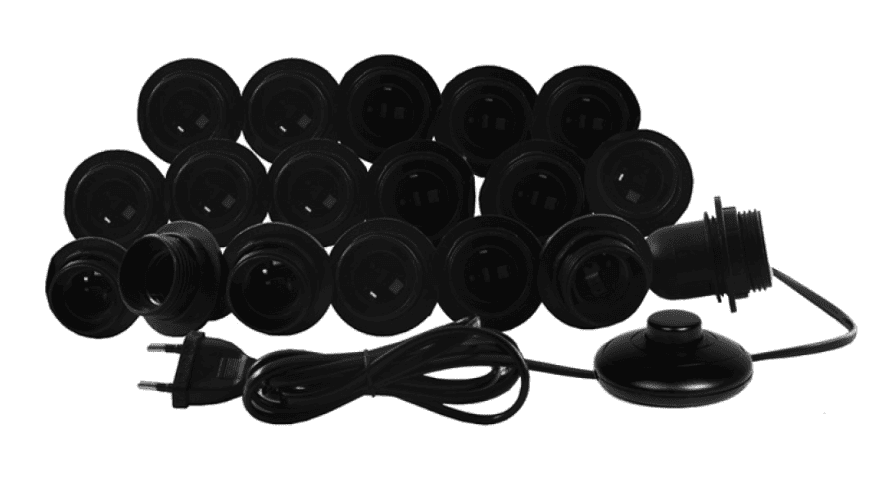 Makeup mirror lighting provides uniform frontal light flow and creates symmetrical lighting across the entire face, which is important for the precise application of foundation, contouring, and selecting cosmetic shades. LED technology allows you to create stable, energy-efficient, and long-lasting lighting that does not distort colors or flicker.
Vertical lights on the sides of the mirror create symmetrical lighting on both sides, minimizing shadows and often used in professional makeup areas. The makeup mirror lighting has a touch switch, dimmer, and color temperature control system, allowing you to adapt the lighting to different conditions—daytime makeup, evening look, or warm light for comfortable use at night.
Power is supplied via a 12V or 24V power supply unit or via an integrated driver connected to a 220V mains supply. Low-voltage systems with a concealed power supply unit are more commonly used for furniture solutions.
Catalog of LEDUA makeup mirror lightings - https://leduastore.com/furniture-lighting-ledua-brand/makeup-mirror-lighting/
Furniture square LED lights 12 volts
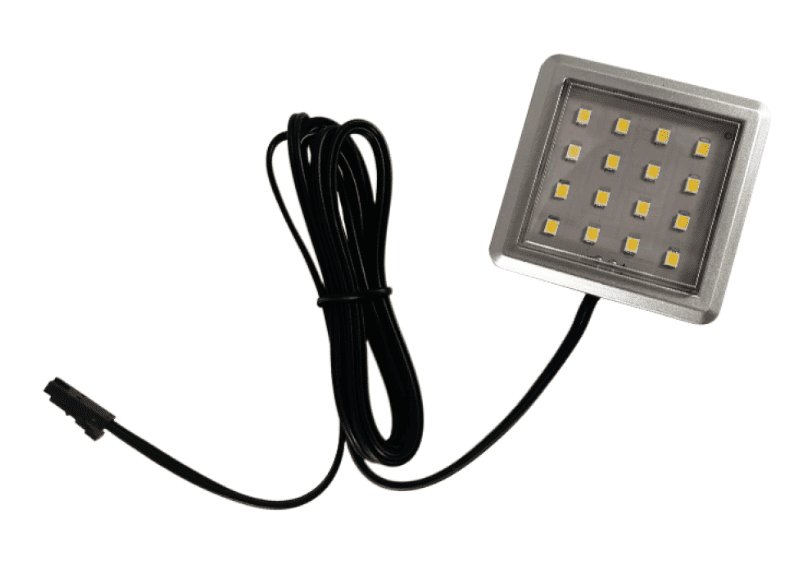 Square 12V furniture lighting fixtures – are compact LED modules with a geometric shape that are used for spot or zone lighting inside furniture structures and operate on 12V DC power via a power supply unit, making them ideal for kitchens, wardrobes, display cases, niches, and decorative shelves. Square furniture light models create a concentrated light accent, allowing you to highlight a specific area of the surface, emphasize items on the shelf, or provide local lighting at a specific point without glare along the entire length of the furniture.
The 12V square lamp consists of a housing, an LED module, an optical diffuser, and a contact group for connecting to a power source. The power of 12V square lamps ranges from 1.5 to 6 W, depending on the model and purpose. The light scattering angle is 90-120 degrees, which allows you to evenly illuminate a section of a shelf or the interior of a cabinet. Square luminaires can be recessed or surface-mounted. In cabinets and wardrobes, square luminaires are installed in the upper part of the body for downward directional lighting.
Catalog of square luminaires for furniture lighting LEDUA - https://leduastore.com/furniture-lighting-ledua-brand/square-12v-luminaires/
Questions and answers about LED furniture lighting
- What components are needed to install LED furniture lighting?
To install LED lighting in furniture, profiles, diffusers, fasteners, connectors, distribution modules, switches, and other mounting elements are used to ensure the correct installation and operation of the system. - What is the purpose of a diffuser in a furniture profile?
The diffuser is installed in the profile to evenly distribute light and form a continuous light line.
- What types of fasteners are used to secure profiles in furniture?
Mounting clips, latches, and pressure plates are used to securely fix the profile. - What connecting elements are used for LED strips?
Straight, corner, and T-shaped connectors are used for quick connection without soldering. - What types of furniture switches are used in LED lighting?
Contact switches, touch sensors, non-contact sensors, and flush-mounted button modules are used. - What types of clips are used for illuminated glass shelves?
Clamping clips with or without an LED module are used for mounting and lighting glass. - What are the options for corner connections in profile systems?
Internal and external corner elements are used to form an angled light line. - What types of sensor modules are used in furniture fittings?
There are motion sensors, door opening sensors, and hand proximity sensors. - What mounting kits are available for installing LED profiles?
Mounting kits include a profile, diffuser, plugs, and a set of fasteners. - What solutions are used for concealed installation of lighting in furniture?
For concealed installation, mortise profiles and special fasteners for installation in a groove are used. - What elements are used for surface mounting of LED lighting?
For surface mounting, surface-mounted profiles and mounting clips are used. - What options are available for connecting multiple light lines in the fittings?
Parallel distribution blocks and multi-channel connectors are used. - Can multiple luminaires be connected to a single driver?
Yes, provided that the total load does not exceed the rated power of the power supply unit. For this purpose, distribution boxes or parallel connections are used. - What color temperature is suitable for kitchen furniture?
For the kitchen, neutral light of 4000K is recommended, which ensures accurate color rendering of products and comfortable visibility. - What switches are used for furniture lighting?
Mechanical contact switches, motion sensors, contactless door opening sensors, or dimmers for brightness control can be used. - Can furniture lighting be installed in ready-made cabinets?
Yes, for this purpose, surface-mounted profiles or ready-made linear luminaires are used, which are mounted without milling. - What solutions are suitable for illuminating glass shelves?
Luminaires for glass shelves or clamps with LED modules are used, which direct light into the end of the glass to create an internal glow effect. - How to hide wiring in furniture lighting?
Cables are laid in the back wall of the furniture or in special channels in the body. Distribution blocks are installed in the ventilation area with access for maintenance.