

 Product added to cart





What is flexible LED neon stripe?
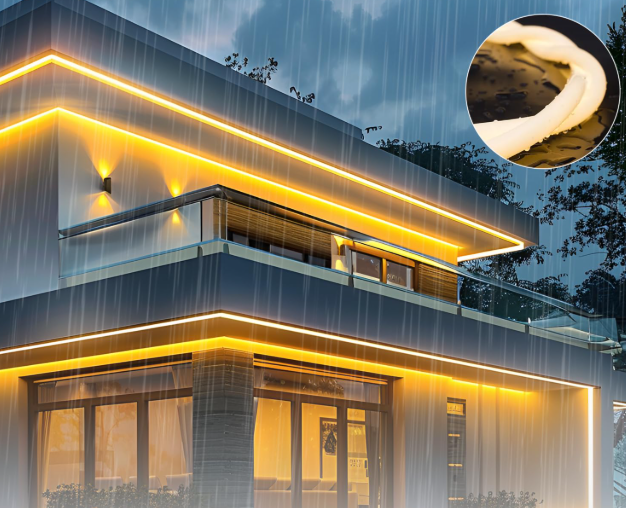
Flexible LED neon strip is a linear LED strip in which LEDs are placed inside an elastic polymer casing with a matte diffuser that forms a uniform continuous line of light. Visually, it imitates classic gas discharge neon, but it works on the basis of LED technology and is powered by low-voltage direct current.
The basis of a flexible LED neon strip is a printed circuit board with SMD LEDs, to which a stabilised voltage is supplied. The board is covered with silicone or PVC compound, which performs three functions at once: mechanical protection, sealing and optical light scattering. Due to the dense arrangement of diodes and the light-scattering layer, individual points are not visible, and therefore a continuous light strip is formed without ‘pixelation’.
The flexibility of the neon strip is achieved due to the elastic body and special geometry of the board. There are models of flexible neon strips with side bending and front bending, which determines the direction of installation on curved surfaces.
Flexible LED neon strip is characterized by the following features:
- Operating voltage — 5V, 12V, 24V or 220V
- Power — from 8 to 15 W per metre, depending on the density of the diodes.
- Luminous flux — on average 600–1200 lm/m.
- Degree of protection — IP65, IP67 or IP68.
- Cutting frequency — 2.5–10 cm depending on the model.
Thanks to its low voltage, LED neon strips are safe for indoor use, in furniture lighting, niches, staircases and shop windows. Neon strip models with a high IP 67-68 sealing class are used on facades, in outdoor advertising and architectural lighting.
How to use LED neon strip?

LED neon strip is used to create uniform light lines in interior and exterior spaces, contour lighting, illuminated lettering and architectural lighting. It is mounted as a standalone linear module and does not require an additional diffuser, as light distribution is already integrated into the design.
Contour and decorative lighting
LED neon strip is used to highlight the geometry of a room — niches, ceiling perimeters, stairs, podiums, arches. Thanks to its continuous glow without visible LED points, it forms a clean line of light without shadow gaps.
For this application, it is important to choose the right light temperature, for example, 3000K for a warm interior, 4000K for neutral lighting; calculate the power of the power supply with a margin of 20-30% and take into account the number of cuts in the tape.
Architectural and facade lighting
Outdoor use of flexible neon strips requires models with a protection class of at least IP67. LED neon strips are used for:
- illuminating facade contours;
- framing shop windows;
- decorative lighting of terraces and canopies;
- light elements on commercial objects.
Installation is carried out on mounting clips or in a profile. The power supply is laid taking into account the length of the line to avoid voltage drops. For sections longer than 5 metres, a two-way connection or power supply from several points is recommended.
Production of illuminated signs and logos
Flexible LED neon strips are widely used in the production of advertising structures. Thanks to their ability to bend along a radius, they allow letters and shapes to be formed without breaks in the light line. The technology involves designing a layout taking into account the minimum bending radius, preparing the base — acrylic, PVC or composite, fixing the tape to special fasteners or in a groove, and connecting it to a stabilised power source.
RGB models of flexible neon strips additionally require a controller to manage colour and lighting modes.
Furniture and zone lighting
In residential and commercial interiors, LED neon strips are used for:
- illuminating kitchen work areas;
- lighting wardrobes;
- decorative lighting of shelves;
- integration into bar counters and reception desks.
Low-voltage 12 V or 5 V power supply ensures safe use indoors. For concealed installation, an aluminium profile is used, which acts as a heat exchanger and additional fastening.
What is the difference between LED strips and neon LED strips?
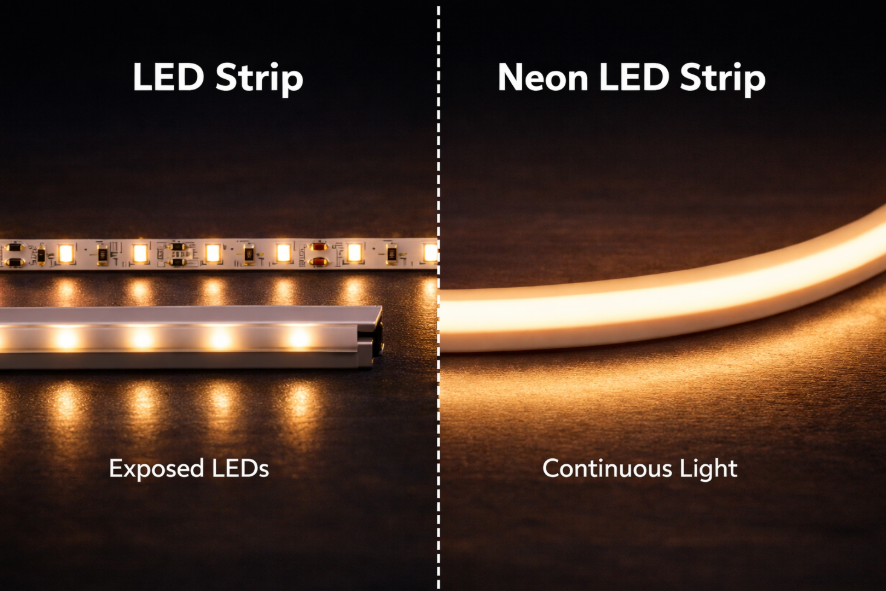
The difference between LED strips and neon strips lies in their design, light formation principle, installation method, lighting effect, energy consumption and area of application. Although both solutions are based on LED technology, their visual result and technical implementation differ significantly.
Design difference
A standard LED strip is a flexible printed circuit board with exposed SMD LEDs and resistors. It has a minimal protective layer or silicone coating, but the LEDs themselves remain visible. Without an additional diffuser, a standard LED strip creates a ‘point’ lighting effect.
Neon strip is an LED board fully integrated into a dense light-scattering silicone or PVC casing. The diodes inside are not visible, and the outer layer forms a continuous line of light.
Visual glow effect
A regular LED strip gives off discrete light, and even with a high density of diodes, there is a minimal gap between the points, which is noticeable without a diffuser. This is suitable for functional lighting, where light output is important rather than the continuity of the line.
Neon LED strip forms a uniform line with no visible dots. The light looks monolithic, similar to classic glass neon, and this property makes it suitable for decorative lighting, light inscriptions and contour lighting, where the purity of the light geometry is important.
Installation and bend geometry
Conventional LED strip is very thin and flexible; it can be glued to a flat surface or mounted in an aluminium profile. It easily repeats the shape of the plane, but is not able to maintain a clear contour without a rigid base.
Flexible neon strip has a larger cross-section and partially retains its shape. There are models with vertical and horizontal bends, which determine the direction of the radius formation. Flexible neon strip allows you to build contours of letters, arches and complex geometric elements without an additional profile.
Lighting characteristics
Conventional LED strips are designed for light output and have a power of 4 to 24 watts per metre, which provides a high level of illumination. This makes them effective for work areas, kitchen surfaces, niches and furniture lighting.
Neon LED strips tend to have lower brightness per metre, as some of the light is scattered within the thickness of the material. Their main purpose is visual uniformity rather than maximum illumination.
Protection and operation
Most neon strips have an IP65–IP67 protection rating thanks to their sealed housing. They are more resistant to moisture and dust, making them suitable for facade use.
A standard LED strip without a silicone coating has an IP20 rating and requires protection when installed outdoors.
Heat dissipation
LED strips must be mounted on an aluminium profile for heat dissipation, as without cooling, the degradation of the LEDs is accelerated.
Neon LED strips partially insulate heat due to their thick silicone layer and are therefore less commonly used for powerful functional lighting and more oriented towards decorative tasks
Installation of LED neon strips
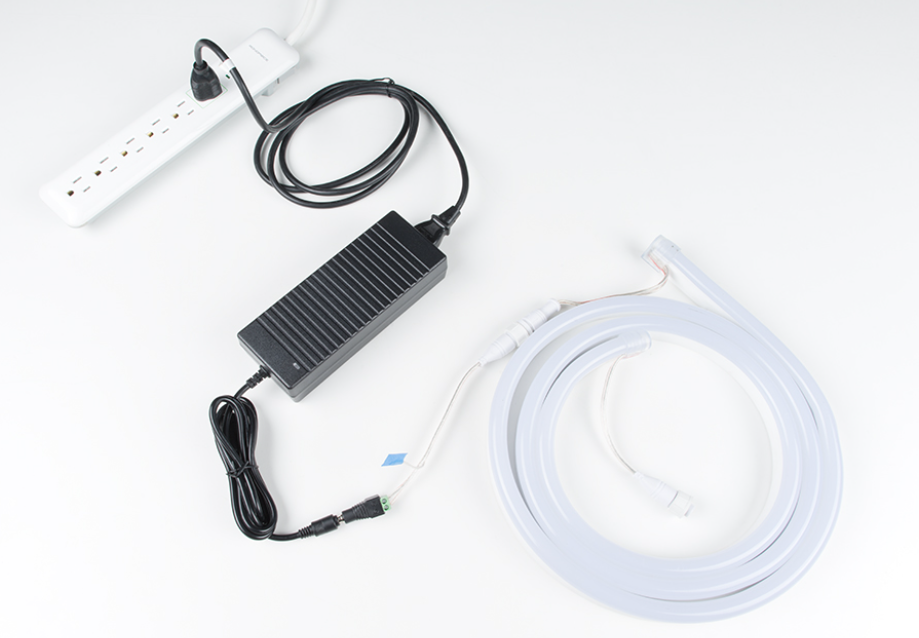
The installation of LED neon strip takes into account electrical parameters, bending radius, heat dissipation and operating conditions. For stable operation, it is necessary to select the right components, prepare the base and follow the connection technology.
What is necessary for the installation of neon strip?
- LED neon strip of the required voltage
- A power supply unit with a power reserve of 20–30%. If the strip consumes 10 W/m and is 8 m long, the minimum power of the PSU must be at least 100 W.
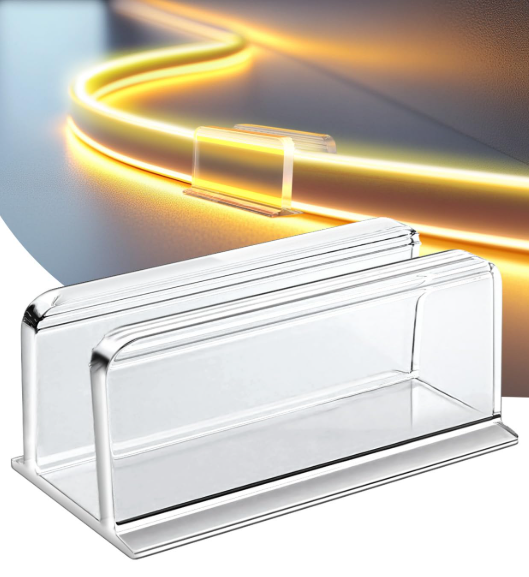
- Mounting clips or aluminium profile compatible with the cross-section of the strip.
- Power cable of the appropriate cross-section.
- Sealed connectors or soldering with subsequent insulation.
- If necessary, a controller (for RGB or dimming).
- Fastening elements: self-tapping screws, dowels or mounting adhesive, depending on the surface.
Preparation for installation of flexible neon strip
Before installation, you need to determine:
- the length of the circuit and connection points;
- the permissible bending radius of a specific model;
- the location of the power supply unit;
- operating conditions — indoor or outdoor environment.
The surface must be flat, dry and free of grease. If installation is on a facade, protection against mechanical tension of the cable and compensation for thermal expansion must be provided.
LED neon strip installation procedure
- Mark the installation line, taking into account bends and joints.
- Secure the mounting clips at intervals of 20–40 cm, depending on the rigidity of the tape.
- Carefully insert the strip into the clips or profile without twisting it.
- Connect the power supply according to the polarity.
- Check the operation of the system before final fixation.
If the length exceeds 5 metres, it is recommended to connect from both sides or use a parallel power supply to avoid loss of brightness at the end of the line.
During installing LED neon strips on facades or in conditions of high humidity, use a model with IP67 or IP6 and seal all connections.
The power supply unit must be installed in a dry, ventilated place. When installed correctly, the strip provides stable, uniform illumination and a long service life even in difficult conditions.
What voltage is required for LED neon strips?
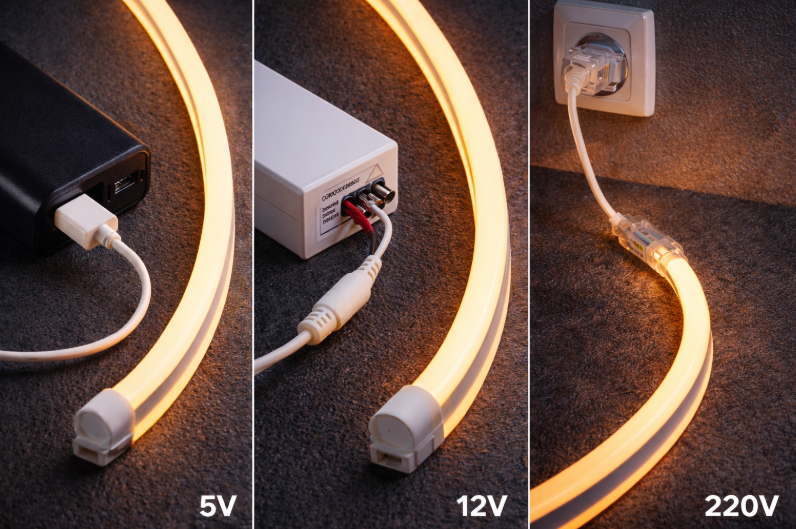
LED neon strips operate on direct or alternating current depending on the type of design. The most common power supply options are 5 V DC, 12 V DC, 24 V DC, and 220 V AC. The specific value is determined by the design of the internal circuit board, the LED connection diagram, and the area of application.
5V LED neon strips
5V LED neon strips are mainly used in short decorative systems. These are compact contour lights for furniture, niches, shelves, or integration into interior elements. A 5V power supply for neon strips can be provided by:
- USB power supplies;
- power banks;
- computer power supplies;
- addressable LED lighting controllers;
- Arduino or ESP microcontrollers.
A distinctive feature of 5 V LED neon strips is their high current at a relatively short line length. Example: if the strip consumes 10 W, the current is 2 A. Because of this, the length of a single section is limited, and for stable operation, it is often necessary to supply power from both ends. Such strips are used where compactness and the ability to power from portable devices are important.
12V LED neon strips
12V is one of the most common power supply formats for LED neon strips, as it is a compromise between safety, line length and glow stability. 12V power is supplied from:
- 220V → 12V switching power supplies;
- 12V batteries;
- car electrical systems;
- charging stations with 12V DC output;
- backup power systems.
The advantage of 12 V LED neon strips is the wide availability of equipment. Power supplies of this type are easy to select in terms of power, they are compact and have overload protection. It is essential to take into account the voltage drop over long distances. For strips longer than 5 metres, parallel connection or power supply from several points is recommended.
12 V LED neon strips are used in furniture lighting, niches, staircases and small advertising structures.
24V LED neon strips
Flexible 24V LED neon strips are suitable for long contours. Higher voltage means lower current at the same power. For example, at 24 V and 10 W, the current is only 0.42 A per metre. This allows you to reduce voltage losses, connect longer sections without losing brightness, and use thinner cable with the same power.
24V LED neon strips are powered by:
- 220V → 24V switching power supplies;
- 24V battery systems;
- inverter backup power supply systems;
- solar systems with a 24V controller.
24V LED neon strips are recommended for facade lighting, long corridors, and commercial facilities where the length of the circuit exceeds 5–10 metres.
220V LED neon strips
There are models of LED neon strips that operate directly from 220V AC. They have a built-in rectifier and driver and are designed for long lines — 20, 30 or even 50 metres without an additional power supply unit. Power is supplied directly from the 220 V mains via an automatic switch or via a timer or light sensor.
The advantage of 220 V LED neon strips is that they do not require a separate power supply and can be installed in long lengths in a single segment. The limitation is the increased insulation and safety requirements. If the casing is damaged, there is a risk of electric shock, so these models are mainly used for outdoor architectural lighting and commercial facades.
What devices can be used to power a 220V LED neon strip?
A 220V LED neon strip can be powered by:
- switching power supplies with the appropriate voltage;
- rechargeable batteries and battery packs;
- a 12V car battery;
- portable charging stations;
- solar power stations via a controller;
- inverters with DC output;
- directly from a 220V mains supply — for models of the appropriate type.
Does flexible LED neon strip can be cut?
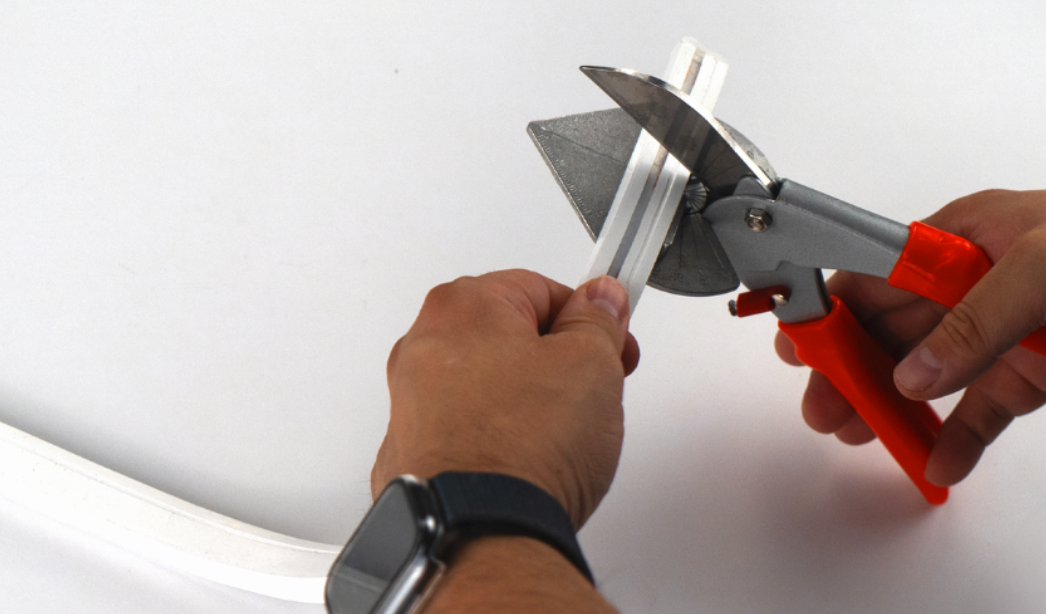 Flexible LED neon strip can be cut, but only in places specifically designated by the manufacturer. Cutting outside the marked areas will damage the internal circuit board and cause part or all of the strip to fail.
Markings are applied to the tape body at regular intervals — usually a black line, a scissors icon or a ‘cut’ symbol. The distance between these points depends on the voltage and design:
- 5V — usually every 1–2 cm
- 12V — approximately every 2.5–5 cm
- 24V — 5–10 cm
- 220V — significantly larger step, often 50–100 cm
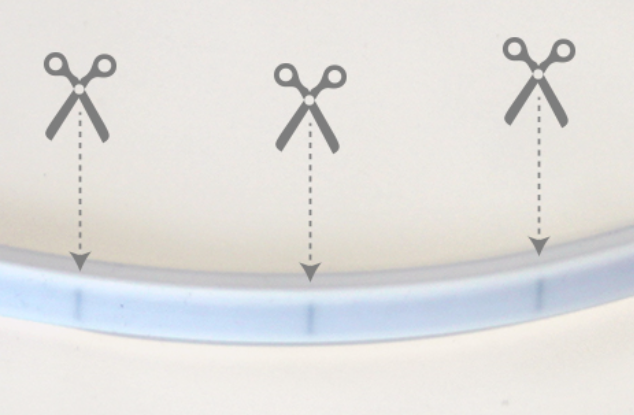
These intervals are determined by the number of LEDs connected in a single electrical segment, and if the strip is cut between segments, the electrical circuit is broken. Inside the silicone casing of the LED neon strip is a printed circuit board with a series-parallel connection of LEDs. Each segment has its own contact pads for connecting the power supply, and it is permitted to cut along these areas.
After cutting, the edge of the casing opens. If the neon strip is used in a humid environment or on a facade, this edge must be sealed with a plug and silicone sealant, otherwise moisture can penetrate inside and cause corrosion of the contacts.
To cut the LED neon strip, it is recommended to use sharp scissors or a utility knife with a straight edge. The cut should be perpendicular to the axis of the strip. If the strip does not light up after cutting, the reason is usually damage to the segment or incorrect reconnection.
What colour does the flexible LED neon strip light up?
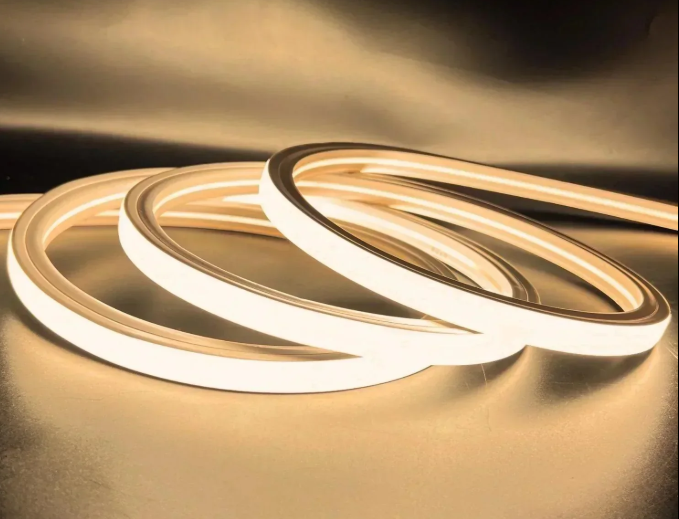
Flexible LED neon strips can emit warm white, neutral white, cool white, or any colour in the spectrum, depending on the type of LEDs installed inside. There are also RGB and RGBW models with colour-changing capabilities.
White light is determined by colour temperature in Kelvin. The most common options are:
- 2700–3000K — warm white, has a yellowish tint, creates soft lighting. Used in residential interiors, restaurants, and recreation areas.
- 4000–4500K — neutral white without a pronounced yellow or blue tint. Suitable for offices, commercial premises, and modern interiors.
- 6000–6500K — cool white, has a bluish tint, visually brighter. Often used in shop windows, technical rooms, and facade lighting.
In addition to white, flexible LED neon strips can glow in a constant colour:
- red
- blue
- green
- yellow
- orange
- purple
- pink
Such models are used for advertising signs, contour lighting of facades, and decorative installations. The colour is determined by the type of LED crystal inside and does not change during operation.
RGB strip contains LEDs with three crystals — red, green, and blue. By combining their intensity, you can get almost any colour. A controller is used to control them, and such strips are used in interior design, stage lighting, and commercial spaces where a dynamic change of atmosphere is required.
Thanks to the silicone diffuser, the LED neon strip forms a uniform line of light regardless of colour, and the glow appears continuous, with no visible dots.
Can a dimmer be used for flexible LED neon strips?
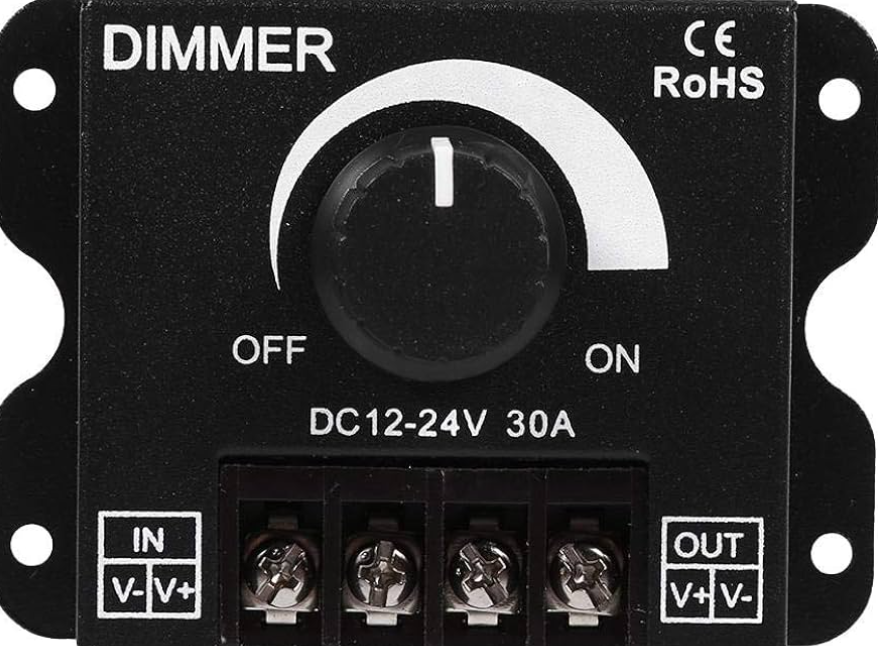
Flexible LED neon strips can be connected via a dimmer if their power supply type and design are compatible with brightness control. Dimming capability depends on the strip voltage, power supply type, and control method.
Low-voltage LED neon strips at 5 V, 12 V or 24 V DC usually support brightness control via a PWM dimmer. PWM is pulse width modulation, which changes the duration of the power pulse without changing the voltage itself. The connection diagram looks like this: 220 V mains → power supply → PWM dimmer → strip
The dimmer is installed between the power supply and the strip and regulates the intensity of the glow without colour loss or overheating of the LEDs. For the right choice, you need to consider:
- the operating voltage of the strip;
- the maximum current of the dimmer;
- the total load power;
- the type of control — push-button, rotary, touch or remote.
For example, if the strip consumes 8 A at 12 V, the dimmer must withstand a current not less than this value with a margin.
For RGB and RGBW models of flexible LED neon strips, a controller is used instead of a conventional dimmer, which allows you to not only change the brightness, but also control the colour. In this case, the circuit is different: 220 V mains → power supply → RGB controller → strip.
The controller contains separate channels for each colour, and the brightness is reduced by software, also via PWM.
220 V LED neon strips support dimming only if specified by the manufacturer. If the model is compatible with a phase dimmer, adjustment is possible without additional devices; if not, dimming is impossible or dangerous.
How to choose LED neon strip for outdoor lighting of a house?
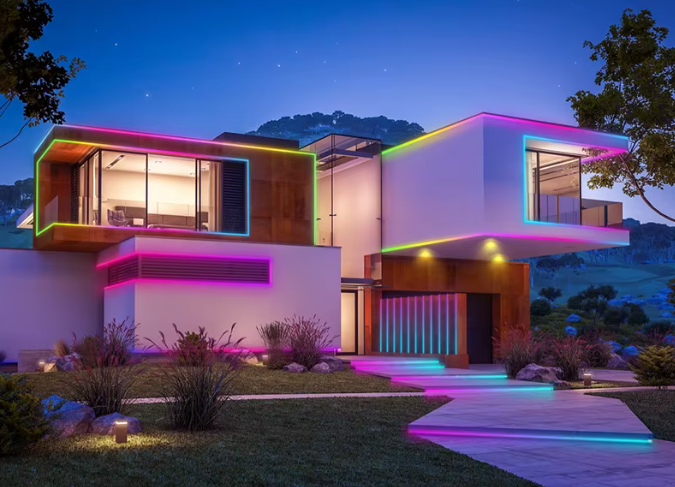
Flexible LED neon strips for outdoor lighting of buildings must meet the requirements for moisture resistance, temperature stability, mechanical strength and line length without loss of brightness.
For facades, cornices, terraces or perimeter lighting, the minimum permissible protection class for neon strips is IP67. This means complete dust tightness and protection against short-term immersion in water. IP65 is only acceptable under awnings or in areas without direct contact with rain. IP68 is used where constant contact with moisture is possible.
Outdoor LED neon strips are designed to operate in a temperature range of at least −20°C to +50°C. For regions with severe frosts, it is advisable to choose models made of frost-resistant silicone, which does not harden or crack at low temperatures. Cheap PVC becomes brittle in the cold and can yellow and lose elasticity at high temperatures.
For outdoor lighting, 220 V neon strips are used because they are suitable for long perimeters — roofs, fences, and large facades. Such strips can operate in sections of 20–50 metres without additional power supplies, while meeting electrical safety requirements and providing high-quality insulation.
Architectural lighting does not require excessive brightness, and the optimal indicator is 800–1200 lumens per metre. Excessively bright strip creates a blinding effect and uneven light reflection from the facade. The angle of illumination is usually 120–180°, and for contour lighting of the roof or cornice, it is important to consider the direction of the light flux — frontal or lateral.
For facades, warm or neutral colours with a glow temperature of 3000K or 4000K are more commonly used, as well as RGB neon strips for decorative or festive lighting.
For outdoor use, the LED neon strip should be attached to mounting clips or an aluminium profile with a mounting interval of approximately 20–30 cm to prevent sagging and deformation when heated. The power cable must have UV-resistant insulation, and the connection points must be sealed with heat shrink tubing or special couplings.
How to choose LED neon strip for the bedroom?
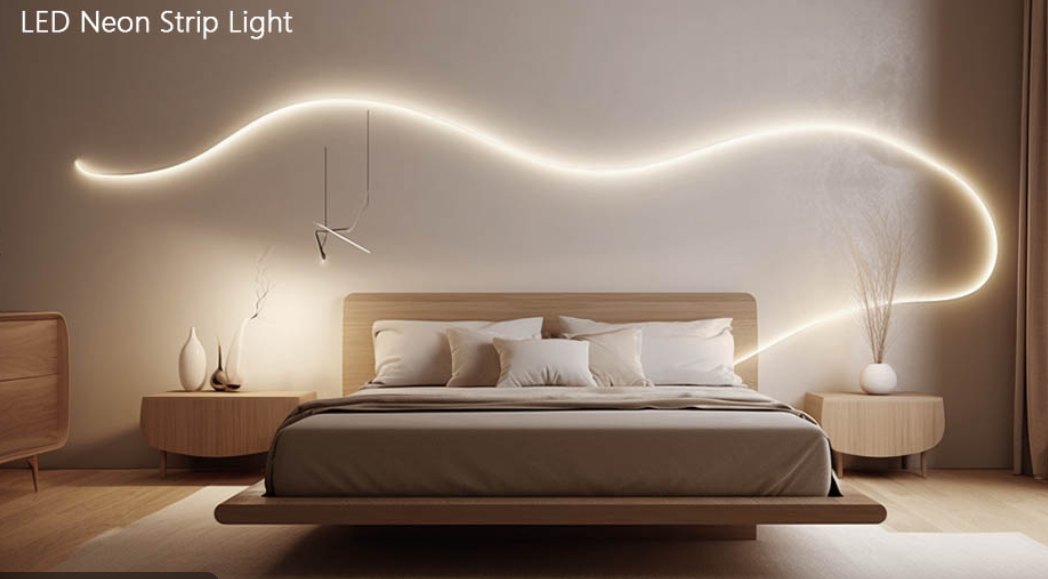
LED neon strips for bedrooms should create soft, even lighting that is comfortable for the eyes, without sharp contrasts or glare. Therefore, when choosing a strip, it is important to consider the colour temperature, moderate brightness, stability of the light, and the ability to adjust the intensity depending on the time of day.
LED neon strip is usually not the main source of light in the bedroom, but serves as contour or atmospheric lighting that emphasises the geometry of the ceiling, highlights the headboard area or creates a soft lighting effect under the bed, forming a sense of depth without direct light in the eyes.
A warm colour temperature in the range of 2700–3000K is optimal for a bedroom, as this spectrum does not suppress melatonin production and does not create the feeling of coldness that is characteristic of 4000K and above. It also helps to relax the nervous system before bedtime and does not cause excessive visual stimulation, which is important for a room intended for rest.
The brightness of LED neon strips for bedrooms should be moderate, and usually a power of 6–10 W per metre is sufficient, as overly bright lighting creates an unwanted light accent and can upset the balance of lighting in the interior.
For bedrooms, 12 V or 24 V DC neon strip models are best suited, as they are safe, stable in operation and do not create high-frequency flickering when using a high-quality power supply. In bedrooms, there is often a need to reduce brightness in the evening, so LED neon strips should support adjustment via a PWM dimmer or a suitable controller.
How to choose a flexible LED neon strip for the kitchen
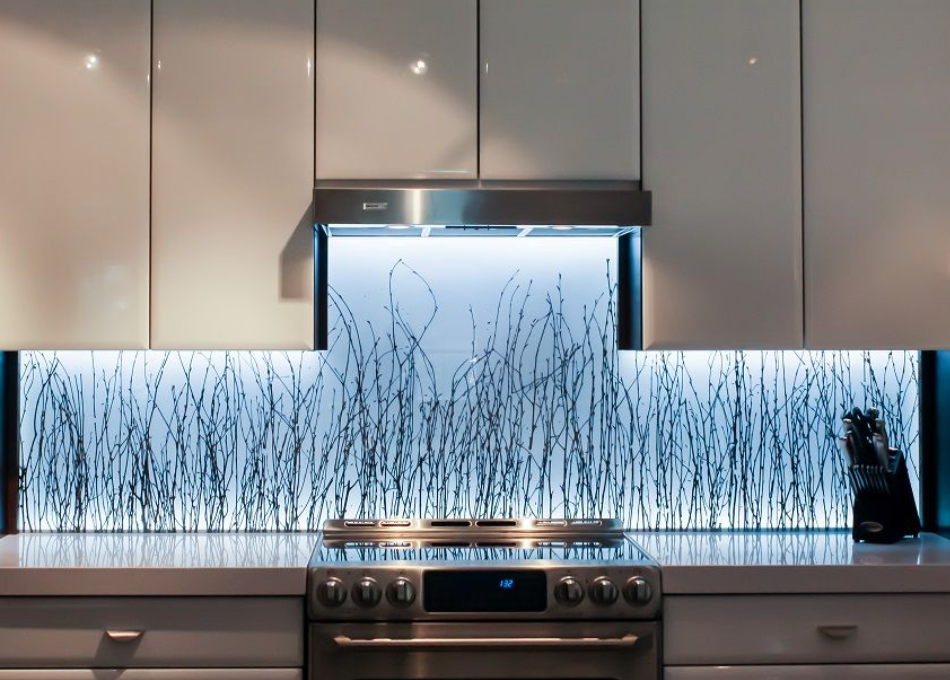
Flexible LED neon strips for kitchens should combine sufficient brightness for the work area, stable colour temperature without distorting the colours of food, resistance to moisture and steam, and uniform glow without visible light points.
First of all, you need to determine where exactly the strip will be installed, since the lighting of the work surface under the wall cabinets requires greater brightness and a neutral spectrum, while the decorative contour of the ceiling or bar area can work in soft lighting mode, forming a general light background without direct strain on the eyes.
For the work surface, a colour temperature of 4000K is optimal, as the neutral white light spectrum allows you to see the shades of products accurately and does not create yellow or blue distortion.
The power of a flexible LED neon strip for illuminating the work area should be within 10–15 W per metre, as a weaker model will not provide sufficient illumination, and an excessively powerful one will create a sharp glare on glossy facades or tiles. For decorative lighting of kitchen niches or the perimeter of the ceiling, 6–10 W per metre is sufficient, but it is important that the light line remains uniform and without darkened segments.
In terms of supply voltage, 12 V or 24 V models are most suitable, and for long kitchen lines, for example, along the entire worktop or perimeter of the room, it is better to choose 24 V, since higher voltage means lower current and, accordingly, minimal loss of brightness at the end of the segment.
Since the kitchen is characterised by high humidity, steam and grease vapours, flexible LED neon strips must have a protection class of at least IP65, which ensures the shell is sealed and the internal circuit board is protected from dust and condensation, while the silicone surface can be easily cleaned of dirt without the risk of damaging the electronics.
How to make a neon light sign from flexible LED neon strip?

A neon sign made of flexible LED neon strip is manufactured by forming a light contour of letters or a graphic element on a rigid base, followed by connection to a power source of the appropriate voltage.
The first step is to develop a sign layout, taking into account the minimum bending radius of a specific strip model. Each flexible LED neon strip has a permissible direction and bending limit, exceeding which leads to deformation of the body or internal board, therefore fonts with overly small elements or sharp angles need to be adapted to the technical capabilities of the material.
After preparing the layout, the base is manufactured, most often from transparent or milky acrylic with a thickness of 5–8 mm, PVC or composite panels. Before fixing the tape, it is cut at the cutting points marked by the manufacturer, after which, if necessary, the wire is soldered to the contact pads with polarity observed, and the connection point is sealed if the sign is intended for outdoor use.
The letters are formed gradually, without sharp bends, while the strip is inserted into the groove or fixed with clips at intervals sufficient to maintain a clear contour geometry, and excessive tension is eliminated.
The electrical connection depends on the voltage of the tape, and for most signs, 12V or 24V DC models are used, which are connected via a switching power supply. If the sign is long or consists of several separate words, it is recommended to supply power to several points to prevent voltage drops in remote segments.
For indoor signs, IP20 or IP65 protection class is sufficient, but for outdoor installation, it is necessary to use strip with a protection class of at least IP67, as well as to provide a sealed enclosure for the power supply unit or install it in a dry room with the cable led outside through a sealed hole.
FAQ about flexible LED neon strip
- What is flexible LED neon strip?
Flexible LED neon strip is a linear lighting module in which LEDs are placed inside a solid silicone or PVC casing with a matte diffuser that forms a uniform line of light without visible dots and imitates classic neon, but operates on low voltage or mains power. - What is the difference between LED strip and neon strip?
A conventional LED strip has exposed LEDs and requires an additional profile for light diffusion, while a neon strip has a built-in diffuser that provides continuous glow, better sealing and a more decorative effect. - What voltage is required for flexible LED neon strips?
The most common options are 5 V, 12 V, 24 V DC and 220 V AC, with the choice depending on the length of the line, installation conditions and type of power source. - What devices can be used to power neon strip?
The strip can be powered by a 220 V → 12/24 V switching power supply, batteries, charging stations, a 12 V car network, a solar system via a controller, or directly from a 220 V network for the corresponding model. - Can LED neon strips be connected without a power supply unit?
Only 220 V models can be connected directly to the mains, while 5 V, 12 V or 24 V strips require a stabilised DC power source of the appropriate voltage. - How to connect a flexible neon strip correctly?
The connection is made through a power supply unit of the appropriate voltage, observing the polarity, calculating the power with a margin of at least 20% and, if necessary, parallel power supply of long sections to avoid voltage drops. - Can flexible LED neon strip be cut?
Yes, but only at the cutting points specifically marked by the manufacturer, which correspond to the electrical segments, after which the edge must be sealed. - What is the cutting pitch for neon strips?
The pitch depends on the voltage: for 12 V it is usually 2.5–5 cm, for 24 V — 5–10 cm, for 220 V — significantly larger, often 50–100 cm. - What colour does LED neon strip light up?
The strip can glow warm white 2700–3000K, neutral 4000K, cold 6000K or solid colours, and there are also RGB and RGBW models with the ability to change colours. - Can a dimmer be used for LED neon strips?
Low-voltage 12V and 24V models support brightness control via a PWM dimmer or controller, while 220V strips can only be dimmed if they are compatible with a phase dimmer. - How much power is needed to illuminate a kitchen?
For the kitchen work area, 10-15 W per metre with a neutral temperature of 4000K is recommended, which provides sufficient illumination without distorting the colour of the food. - What protection class is required for outdoor lighting?
For facade mounting, IP67 or higher is recommended to ensure waterproofing and protection against dust and moisture. - Why is 24 V better than 12 V for long lines?
24 V creates less current at the same power, which reduces voltage loss and ensures uniform brightness over long distances. - Is LED neon strip suitable for main lighting?
In most cases, it is used as decorative or contour lighting, as its main advantage is a uniform light line, rather than maximum light output. - How to make a neon sign from LED neon strip?
You need to prepare a layout, a base made of acrylic or PVC, form a contour taking into account the bending radius, cut the strip correctly and connect it to a power supply unit of the appropriate power. - Does flexible LED neon strip flicker?
High-quality strip does not flicker when connected to a stable power supply, whereas flickering may occur when using cheap drivers or an unstable network. - Does the neon strip heat up?
The strip heats up during operation, but the level of heating depends on the power, installation conditions and heat dissipation, so for power ratings above 12–14 W per metre, it is advisable to use a profile or metal base. - What is the service life of flexible LED neon strip?
High-quality models have a service life of 30,000–50,000 hours, provided that they are powered correctly and the operating conditions are observed. - Is LED neon strip safe for the home?
12 V and 24 V models are considered safe for residential premises as they operate at low voltage and do not contain gas or fragile glass elements characteristic of classic neon.